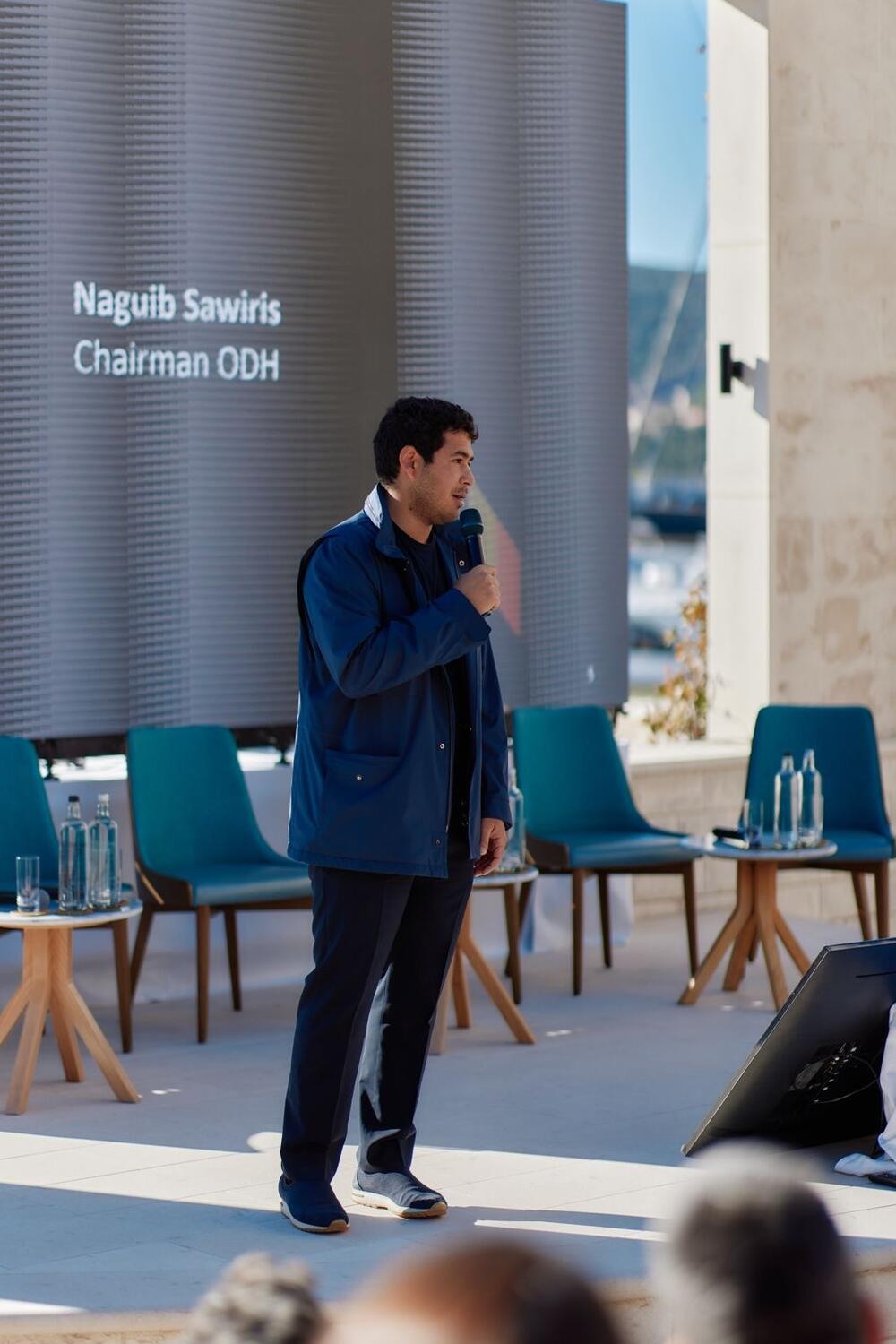
Naguib S. Sawiris, Chairman of the Board of Directors of "Orascom Development Holding", stated that due to the unpredictability in issuing permits and financing, it is difficult to precisely announce what will be completed in the Luštica Bay settlement over the next three years, but that the development of the destination is certain.
In an interview with "Vijesti", he said that in 13 years of operating, "Orascom" has not taken "a single euro" out of Montenegro, but that everything earned here has been reinvested, and that the master plan foresees at least another 800 million to one billion euros of investment.
Sawiris also said that delays and complex procedures in the fields of planning, permit issuance, and cadastre have begun to affect the project's dynamics and the company's finances, while the project, as he claims, is larger than local banks can bear. He praised the cooperation with Prime Minister Milojko Spajić and his commitment to accession to the European Union.
Speaking about the engagement of former Minister of Tourism Predrag Nenezić at "Luštica Development", Sawiris said that in his case too, the criterion was quality, not political affiliation.
He also rejected any business ties with the President of Serbia Aleksandar Vučić or his relatives, while for former strategic director Dejan Ljevnaić he said that the cooperation was terminated solely on the basis of business criteria.
Since you took over responsibility for the project, what have you changed compared to the original concept, and what specifically will be completed by the end of 2027, 2028, and 2029? Can you name at least one major building, infrastructure project, or facility for each of those three years?
The essence hasn't changed. Luštica Bay should be the leading destination on the Adriatic - a destination that respects the coast and the architectural heritage of the bay. What I have done is sharpen that concept further. As a group, we have decided to focus on a smaller number of destinations, and I demand of myself and the entire team that we realize each of them at the highest level. Luštica Bay is one of those destinations. Building a new town takes 40 or 50 years, not three. Our master plan is divided into approximately 70 projects - from hotels and golf courses, to sports facilities, and every year we adjust the dynamics to what the market truly needs. That is why I won't announce in advance what exactly will be completed in 2027, 2028, and 2029. Our teams on the ground will provide that information when the time comes. What I can tell you is what our priority is: for Luštica Bay to be attractive throughout the entire year, including winter. And we have momentum. This year we completed nine holes of the golf course, we look forward to completing all 18, and we are also planning another five-star facility, based on the concept of longevity and wellness, precisely with the aim of extending the season beyond summer. Still, allow me one friendly remark, with a smile - it is difficult to make firm three-year commitments when there is no predictability regarding the issuance of permits and financing. As for the destination itself, the question is when, not whether.
According to Government data, by mid-2025 about 637 million euros had been invested in the project, while approximately 11 percent of the planned building area had been realized. Are such dynamics in line with the original plan and contractual obligations? What exactly is included in the reported 637 million euros of investment? How much of that amount represents Orascom's direct capital, and how much is loans, money from property sales, buyer advances, infrastructure investments, and other items? How much has Orascom invested of its own money that did not originate from loans or the project's own revenues?
The Government checks all of that against clearly established indicators, and I accept official data as authoritative. Still, there is one distinction that is important for your readers. Some investments create the destination itself: infrastructure, the marina, hotels, the golf course into which more than 60 million euros have been invested. The others are investments with a shorter cycle, in residential units that we build and sell. That first type of investment comes first, carries the risk, and enables everything else. Our master plan foresees at least another 800 million to one billion euros of such investments. And here is a fact I am proud of - in 13 years we have not taken a single euro out of Montenegro. Everything earned here has been reinvested here.
By mid-2024, Luštica Development had generated approximately 293 million euros in revenue, while the calculated turnover rent of two percent amounted to about 5.3 million euros. How much has the state received in total since the beginning of the project through rent, taxes, lease, fees, land, shares, and dividends? How much, by year and on what grounds, has been paid to the state, and how much to the Municipality of Tivat?
I repeat, the state checks that data and, when it does, I would encourage it to publish it. We fully act in accordance with the Land Development Agreement. I would only caution that a snapshot at this stage of the project may create a misleading picture. Over the next three to four years, more property owners will join us than during the previous ten, and there is also a time gap between the moment we sell something, when we book the revenue, and when the payment obligations fall due. But something else is more important. The real benefit for the state is not reflected in direct payments. Likewise, the fact that in 13 years not a single euro has left Montenegro shows that our model is not based on extracting money. The real benefits are indirect. How many more tourists come to Montenegro because of this project? How many ships sailing between Croatia and Greece today stop at Mamula or in the Luštica Bay marina? How many contractors, small business owners, and suppliers have work they simply would not otherwise have - and how much tax and fees do they all pay? That is the real balance sheet. By every measure, we are among the three largest investors in this country. When the report is published, call me again and we will go through it together. Just keep in mind that we think in decades. We are still at the very beginning, and we are proud of that. The same applies to Andermatt in Switzerland and El Gouna in Egypt, which are much older than Luštica Bay.
The agreement allows the transfer of rights to leased state land to property buyers. How much land has been transferred so far, how much has the company charged buyers, and how much has the state received? In your opinion, are the fees of four, 15, and 80 euros per square meter, agreed more than 15 years ago, still fair in relation to today's market value?
This question goes to the very core of the partnership, so I want to be precise. Those amounts are fees for the right to use the land, not the value of the land itself, and these are the base fees from 2009. They increase every year according to a formula agreed in the contract. When we signed the agreement, Luštica Bay was just as beautiful as it is today, but completely undeveloped. There was no infrastructure, no international hotels, the destination had no established name, and connectivity was poor. The marina, hotel, and golf course barely cover their running costs; they never return the capital invested in them. The economics work only if the land gains value and if the residential units are sold thanks to that appreciation. Retroactively changing the price of the land, after the risk has already been taken and the money spent, would mean destroying the logic of the entire investment. It would also destroy the credibility of any government that did so. A partnership like this survives or fails depending on the stability of the rules.
The group operates 18 affiliated companies that generate revenue from various activities. Is the turnover rent of two percent calculated on the consolidated revenues of the entire group or only on the revenues of Luštica Development AD? In other words, does the reported 293.3 million euros include the turnover of all 18 companies?
As I understand it, the reported amount covers the group, excluding hotels, which is in line with the way we report on all our operations worldwide. We manage each destination through separate companies. This way, responsibility is clearly delineated, and partnerships and financing are simpler. Moreover, we are a Switzerland-based company. Each of those companies is subject to annual audit by domestic and international auditors, and our compliance standards are set accordingly. We strongly insist on transparency. That is how we operate everywhere.
The agreement was signed in 2009 by Milo Đukanović and Samih Sawiris. Predrag Nenezić and Nebojša Popović, who had previously held important state functions related to the project, later moved to Luštica Development. How do you explain those transitions, and did relations with the government at the time influence the conditions the company received? Did Nenezić or Popović, while in state service, participate in negotiations or decisions relating to Orascom or the Luštica Bay project?
We apply the same criterion in every hiring, including theirs: we select people based on their qualities. As an international developer, we apply compliance standards that most often significantly exceed the requirements of local legislation. But I will be open about the context. Montenegro is a small country, with a limited number of people who have the experience for top managerial positions, and politics reaches everywhere. Everyone knows everyone, accusations arise quickly, so ordinary business decisions about hiring or engaging contractors are interpreted through a political lens. We are strictly politically neutral, and I want that on the record ahead of both the elections and the negotiations on accession to the European Union. Our only focus is the success of Luštica Bay - for the benefit of all citizens of Montenegro
You often praise the cooperation with Milojko Spajić's Government. What specifically have you asked of it, what has been approved for you, and what requests are still being negotiated? Are you seeking changes to the agreement, planning documents, deadlines, or the company's financial obligations?
First, credit should be given where it is due. Leading the process of accession to the European Union is not easy, especially when at the same time you are leading a coalition government, and I have seen the Prime Minister's commitment to that process. According to all public opinion polls, that is the will of the citizens. As for us, the agreement is valid until 2104, and the state is also a shareholder and holds two seats on the Board of Directors, so ongoing dialogue with the Government is simply part of the nature of this project. Prime Minister Spajić and his team maintain an open channel of communication. Two main problems are already known to the public. The first is permits: delays and the complexity of procedures in the fields of planning, permit issuance, and cadastre have accumulated to the extent that they affect both the project's dynamics and our finances. The second is financing: the project is larger than local banks can bear, both in terms of the volume and the maturity of the required loans, so we are sometimes forced to take on the role of a bank ourselves and provide credit to future property owners. In addition, among the strategic topics we are discussing are air connectivity, joint marketing of the destination in the European markets from which our guests come, and creating real reasons for tourists to come outside the summer season as well.
The Government revoked the conclusion by which it had approved a mortgage for a loan with Alta banka. What explanation did you receive from the Government for withdrawing consent for the mortgage?
Our local team had previously exhausted the options with Montenegrin banks, taking into account the size and development stage of the project. Earlier we obtained approvals for arrangements that included regional banks, and we had already worked with this particular bank. Our position is simple. We respect the sovereign decisions of the Government, provided they remain within the framework of our agreement, that there is a clear and documented rationale for them, and that decisions are made in a timely manner and are not subsequently revoked. Besides, we are apolitical and focused on building Luštica Bay.
Why are rights related to state property used as collateral instead of shares or other assets of the private investor? Is the goal for Orascom to free up its shares for other financial arrangements? What happens if the company is unable to repay the loan? Do those rights pass into the ownership of the bank?
That is standard practice in real estate project development, applied everywhere, and in Montenegro there is also established case law regarding it. To be precise: we pledge the right to use the land - the right of usufruct, not the property itself, and the agreement explicitly allows this. And understand why we do it. Not to pay out dividends; over 13 years everything has been reinvested. We do it because financing enables the developer to build faster. You cannot pledge infrastructure or a golf course. The value they create is reflected in the value of the rights to the land, and unlocking that value finances the next construction cycle.
Although it has been denied several times, opposition media and politicians in Serbia link that bank to the President of Serbia Aleksandar Vučić. Apart from the loan with Alta banka, are you connected to the Vučić brothers through other business arrangements?
To be completely explicit, so there is no doubt whatsoever: we have no business arrangements with the President of Serbia nor with his relatives. As for the rest, you probably know more about the allegations regarding that bank than I do. We are a Switzerland-based company, focused exclusively on business, strictly apolitical and with no agenda other than the economic development of Montenegro. If the state wishes to ban certain companies from operating in the country, that is a decision to be made by the Government, not us.
You have been operating in Montenegro for years and occasionally stay here. How do you see Montenegro today as a state and a society, and what do you consider its greatest challenges?
I will use this question for an appeal. The citizens of Montenegro should hold their politicians accountable above all for one thing: a better quality of life. Healthcare. Education. Economic development. I have two ideas on how to achieve that. First - you are more similar than you are different. I see too many politicians who put their party ahead of their country, and much of that comes down to distrust among different groups. I have seen both sides of this - between Christians and Muslims in Egypt, as well as among people who speak French, German, and Italian in Switzerland. Where things work, they work because people cooperate despite those divisions. Because they are first and foremost Egyptians. First and foremost Swiss. The successful countries are those in which people work in the interest of the whole society, not of particular groups. Second - abundance instead of scarcity. In Luštica we do not see ourselves as competition to Porto Montenegro or the resorts in Budva. Our job is to grow the whole pie, not to fight over who will get the largest slice of a pie whose size stays the same. When we succeed, everyone else advances alongside us. It is not at anyone's expense. If more people here start asking how to grow the economic "pie", Montenegro will surprise the world. That requires putting Montenegro first. We have been doing that for 13 years. And we do not intend to stop.
Up to 1,500 employees
How many citizens of Montenegro are permanently employed on the project, what is their average salary, how many local people hold managerial positions, and what is the value of the work awarded to domestic companies? Which beaches, parts of the coast, and promenades will permanently remain freely accessible to citizens?
The numbers change from month to month, depending on the season, and you have to count both the employees in the company itself and all those who work in jobs connected to Luštica Bay. Roughly: we have 525 directly employed permanent staff, plus 180 to 190 seasonal workers. Another 300 to 400 jobs exist in partner companies operating in Luštica Bay, while in total we are talking about approximately 1,400 to 1,500 jobs when you include the wider economic activity we generate in the Tivat Bay area. We hire and promote people based on their abilities and results, without discrimination on the basis of nationality, gender, ethnicity, or political affiliation. We engage employees from abroad only where a particular position requires deep knowledge of how the Group operates. Of the eight members of our current top management team, not counting the CEO, five hold a Montenegrin passport. We also buy locally wherever quality allows. As for access, Luštica Bay is open. We do not believe in closed enclaves, and day visitors from all parts of Montenegro are welcome. Yes, at the peak of the season there are moments when it is very crowded. Some property owners have expressed concern, and we will address that pragmatically, among other things by giving owners a greater voice in decisions that affect them.
Strategic director Dejan Ljevnaić was recently dismissed. His name came into the focus of the regional public after posts by former RTRS journalist Nataša Miljanović Zubac about alleged corrupt dealings at the Jahorina Olympic Center, over which the prosecutor's office there opened a case and launched an inquiry. He then again appeared in the media over the arrival of 87 security-relevant persons from Serbia at the airport in Tivat, ahead of the opening of the EU - Western Balkans Summit 2026 in Tivat. He allegedly arranged accommodation for them in a complex managed by your company. Who recommended Ljevnaić to you for the position from which he was recently dismissed? Was he dismissed because of his connection to bringing in security-relevant persons from Serbia, the investigation in Republika Srpska, or for some other reason?
I have no knowledge of any role Mr. Ljevnaić may have played in the arrival of that group, and I will not comment on allegations relating to the period before his engagement with us, nor on proceedings that are still ongoing. We are not the judiciary and we know our limits. What I can say is the following - he was engaged based on his qualities and on what he could contribute to Luštica Bay, and we terminated the cooperation solely on the basis of business criteria. As Chairman of the Board of Directors, I will not allow any party to use this company for its own ends. Besides, honestly, I sympathize with him. He is an experienced executive in the tourism industry who moved to Montenegro to apply his knowledge and experience here, and to this day a lot of dust has been kicked up around him, while, as far as I know, he has not been charged. Instead of spending his time advancing Luštica and Montenegro, he has to spend it defending himself. That is a loss for everyone.